PRESIDENT'S MESSAGE
School starts Aug. 18 — and with it, school-bus stops, morning drop-off traffic, and kids crossing streets who weren't out there in July. Slow down, put the phone away, and give buses room to stop. A few extra seconds beats a lifetime of regret.
This issue also launches Safe Roads for Great Falls, a new CFGF series on the everyday hazards on our roads — school buses, e-bikes, headlight glare, and more. You'll find the first two installments below.
Your Board had a busy summer — watching zoning and land-use proposals headed to the Board of Supervisors, and raising concerns about the data centers reshaping Virginia's energy landscape. Fairfax County has let too many of these get built by right, with real noise, pollution, and visual impacts on neighboring communities. That deserves more scrutiny, not less.
Richmond's in our sights too, as the General Assembly gears up for its next session. We'll track legislation on land use, transportation, and the environment, and let you know when it's time to weigh in.
Thanks for everything you do to keep Great Falls Great Falls. Here's to a great start to the school year.
— John Halacy, President
CIVIC ENGAGEMENT
Starts With Participation
Fairfax County's primary is Tuesday, Aug. 4 — and yes, primaries matter. They decide who's even on your ballot come November.
CFGF doesn't endorse candidates. But we do believe an informed, engaged community is a strong one. So: check your registration, learn where candidates stand, and vote if you're eligible.
And don't stop there. Show up to a public hearing. Join a community meeting. Email your Supervisor. Every one of those counts as civic engagement, too — and every voice moves the needle.
TREE COMMISSION
Don't Let Fairfax County Dismantle 53 Years of Tree Protection Expertise
The Board of Supervisors is set to dissolve the independent Tree Commission on Aug. 25. Great Falls residents need to speak up now — before the chainsaw falls on our canopy.
Fairfax County is quietly moving to eliminate the 53-year-old Tree Commission and fold its work into a new “Environmental Commission” alongside the Environmental Quality Advisory Council. County staff are calling it a harmless efficiency measure.
It is not.
It's the dissolution of an independent advisory body that has protected our urban forest since 1973 — and the consequences, for Great Falls and for canopy equity countywide, are serious.
What we stand to lose:
- 53 years of institutional memory. The Tree Commission built the Tree Action Plan, helped enact the Tree Conservation Ordinance, and has reviewed county actions affecting our canopy since 1973. You can't rebuild that inside a generic environmental board.
- A dedicated, focused voice. Folded into a bigger commission, tree protection becomes one agenda item among many — right when development pressure on sensitive land here is at its highest.
- Canopy equity gains. The Tree Commission drives tree-planting projects in underserved neighborhoods, tied to the county's goal of 60% canopy coverage by 2030. Dissolving the body doing that work risks losing ground in the places that need it most.
The county's numbers don't add up either: about $20,000 in savings and 600 staff hours, against the permanent loss of a proven watchdog. The new commission's bylaws aren't even written yet. The Tree Commission's July meeting was already canceled, and its Sept. 3 meeting may never happen.
Here's what to do before Aug. 25:
- Testify at the Aug. 25 public hearing (Fairfax County Government Center, Board Auditorium). Sign up online through the Board's “Speak at Board Meeting” portal, or in person. Two or three sentences carries weight.
- Submit written comments to the Clerk to the Board of Supervisors — it becomes part of the official record even if you can't attend.
- Email and call Supervisor James N. Bierman, Jr. (Dranesville District): dranesville@fairfaxcounty.gov • McLean office 703-356-0551 • Herndon office 703-471-5076.
- Copy Chairman Jeffrey C. McKay's office too: 703-324-3187, clerktothebos@fairfaxcounty.gov.
- Say this: “Oppose the dissolution of the independent Tree Commission. Keep it a stand-alone body with the expertise to protect our urban forest and advance canopy equity.”
- Forward this to a neighbor. Bring a friend on Aug. 25. Turnout is what moves a Board vote.
The Tree Commission earned its independence over 53 years. Let's make sure the Board knows we intend to keep it that way.
SAFE ROADS FOR GREAT FALLS
A Citizens for Great Falls Transportation Safety Initiative
Introducing a New Conversation About the Roads We All Share
Great Falls roads are narrow, winding, shaded, and often unlit — shared every day by school buses, commuters, cyclists, runners, and kids walking to a friend's house. Most of us don't think twice about them. Until we do: a close call, a near-miss, a piece of news that reminds us how much trust we place in the driver coming the other way.
That's why we're launching Safe Roads for Great Falls — a new series on the everyday safety issues that touch all of us, whoever's behind the wheel, on two wheels, or on foot.
Over the coming months, we'll cover:
- School bus safety
- E-bikes and e-scooters
- Aggressive driving
- Truck safety
- Nighttime headlight glare
- Rural road safety in Great Falls
- Pedestrian and cyclist safety
This isn't about pointing fingers — drivers, cyclists, and pedestrians all share the road, and the responsibility. Some of these, like headlight glare, aren't among Virginia's top crash causes. But good policy catches problems early, before they turn into crises.
This month, we're starting with two: growing concern over e-bike and e-scooter safety, and a question a lot of you have asked us after dark — are today's headlights too bright? Read on for both.
Safe Roads for Great Falls is a CFGF initiative promoting safer travel for motorists, pedestrians, cyclists, school children, and first responders through education, engagement, and advocacy.
SAFE ROADS FOR GREAT FALLS
The Growing Presence of E-Bikes and E-Scooters: Convenience Meets Concern
Electric bikes and scooters are everywhere in Northern Virginia now — quick, cheap, easy on the environment. But as they've multiplied, so have the safety concerns, especially here.
Our roads weren't built for this. Georgetown Pike, Walker Road, Beach Mill, Springvale — narrow, high-speed, two-lane roads with few sidewalks and no bike lanes, shared by cars, cyclists, runners, horses, and now e-bikes and scooters too. Add in the aggressive driving Northern Virginia is known for, and a collision between a 4,000-pound vehicle going 45-55 mph and someone on an e-scooter rarely ends well.
This isn't theoretical. On July 23, a 9-year-old boy was killed riding an electric scooter in Herndon when he collided with a car. He wasn't wearing a helmet. The crash is still under investigation, but it's a gut-punch reminder that even a quiet street or a parking lot can turn dangerous fast.
Part of the problem: e-bikes and scooters are quiet, fast, and easy to underestimate. Drivers don't always see them coming. And the riders most likely to be on them — kids and teens — don't always have the judgment yet to ride defensively among cars. These aren't toys: many go 20 mph or faster.
So we're asking:
- Do riders and parents understand how fast this technology, and the risk, is changing?
- Are kids getting real safety training before they ride?
- Does everyone know the actual rules — helmets, where you can legally ride?
- How do we all share the road better?
- What can families do, right now, to lower the risk?
This isn't just a police matter — it's a conversation for parents, schools, and neighbors. Tell us what you've seen: unsafe riding, unsafe driving, an intersection that worries you. Let's find the fixes before there's another tragedy.
KNOW THE LAW
Virginia's Rules for E-Bikes and E-Scooters
E-bikes and scooters are everywhere now — carrying kids to school, commuters to work, neighbors around town. Here's what the law actually requires, so riders, parents, and drivers can keep each other safe.
E-bikes: Virginia sorts them into three classes. Class 1 and 2 top out at 20 mph (Class 2 adds a throttle); Class 3 goes up to 28 mph and needs a speedometer. No license, registration, or insurance required for any of them.
E-scooters: Riders must obey traffic signs and signals and yield to pedestrians — the same courtesy expected of anyone on the road. Localities can set their own rules on where scooters are allowed, so check yours.
Helmets: Virginia doesn't require them statewide. But Fairfax County does, for riders under 15, on bikes, e-bikes, and e-scooters alike. Whatever your local law says, wear one anyway — it's the single best defense against a serious head injury, and as our companion story shows, the stakes are real.
Good habits for everyone: Helmet, every ride. Lights and reflective gear after dark. Ride like no driver has seen you. Follow the same traffic laws as any other vehicle — no headphones, no phone. And for kids: ride where your actual skill matches the traffic, not just where the rules technically allow it.
Drivers owe riders too: give them room when passing, slow down where visibility is limited, and stay alert at intersections and neighborhood streets.
A little courtesy and awareness, from everyone, is the difference between a routine trip and a tragedy.
SAFE ROADS FOR GREAT FALLS
This Month's Installment: Are Today's Headlights Too Bright?
When Did Driving at Night Become an Endurance Test?
You know the moment: an oncoming car's headlights hit you, and for a second the road, the shoulder, the cyclist up ahead all disappear behind a wall of glare. On our winding, unlit roads, that's not just annoying — it's dangerous.
Modern LED headlights are great for the driver using them, and brutal for everyone else. Add taller SUVs and trucks, misaimed headlights, and illegal aftermarket lighting, and the problem compounds.
To be clear: headlight glare isn't among Virginia's top crash causes. Distracted driving, speeding, and impaired driving are much bigger threats. But smart policy catches problems before they get worse, not just after.
Virginia's annual vehicle inspection program already checks brakes, tires, and lighting. That's the natural place to start: ask state police, DMV, and safety experts whether today's inspections actually catch dangerous headlight aim and illegal lighting mods. No new law needed yet — just a hard look at whether the rules have kept pace with the technology.
Technology should make the road safer for everyone, not just the driver with the brightest headlights.
TRANSPORTATION
Project Update: Utterback Store Road / Loran Road Pedestrian Improvements
CFGF has been pushing Fairfax County to fund pedestrian safety improvements at Utterback Store Road and Loran Road, next to Forestville Elementary School. Here's where it stands — and why it matters.
Utterback Store Road feeds directly off Leesburg Pike (Route 7), where the speed limit is 55 mph. Cars turning onto it often haven't slowed down yet — and kids, parents, and neighbors currently cross that road with no dedicated pedestrian infrastructure at all.
The ask: about 1,100 feet of new pedestrian path, a marked crosswalk at Loran Road, ADA curb ramps, and better signage.
The research backs it up. Pedestrian injury risk climbs fast with speed — from about 10% at 16 mph to roughly 90% at 46 mph, per AAA Foundation research. High-visibility crosswalk markings roughly double the distance at which drivers spot a crossing, and are linked to crash reductions of 23-48%, per VDOT. And under Virginia law, a marked crosswalk gives students unambiguous legal right-of-way — not left to chance.
The bad news: the project is still stuck in the county's design phase, with no construction date and no funding guarantee. County staff say funding only stretches to a handful of projects per district, and this one may not make the cut this round.
CFGF isn't done pushing. We'll keep advocating for funding and keep you posted as this moves — or doesn't.
Sources: FHWA-HRT-04-100 (2005); VDOT Bicycle and Pedestrian Treatments guidance; AAA Foundation for Traffic Safety (Tefft, 2011); Code of Virginia Section 46.2-924.
UTILITIES & INFRASTRUCTURE
Who Pays for the Grid? Data Centers, Rising Demand, and Your Electric Bill
Data centers are the reason Virginia's economy, and increasingly your electric bill, look the way they do. Northern Virginia has more data center capacity than anywhere on Earth, and AI is only accelerating that growth. Here's the question worth asking: who pays for the grid upgrades all that demand requires?
Data centers run 24/7 and eat enormous amounts of power. That demand ripples through the shared regional grid, pushing up costs for everyone — and it's not slowing down. Meeting it means new power lines and substations, and that money has to come from somewhere.
Here's the risk: a 2024 study by Virginia's nonpartisan JLARC found unchecked data center growth could add up to $18 billion to the state's power costs by 2040 — and residential customers could end up covering part of that bill. To be fair, JLARC found no evidence that's happened yet; data centers are currently paying their fair share. The concern is what happens if growth outpaces the rules.
Regulators have started closing the gap. In late 2025, Virginia created a new rate category requiring large customers like data centers to put down a hefty deposit, so their grid upgrades don't get passed on to everyone else. It doesn't cover every cost yet — like certain local power lines.
This year's General Assembly took up bills to close more gaps: one that could shave about $5 off your monthly bill by shifting more cost onto data centers; another that stalled in the House. Meanwhile, your bill is already rising — Dominion's approved 2026 rate increase adds about $16 a month, even as more cost shifts to data center operators. A new state tax on data center electricity use starts this year too.
Fair warning: this one's genuinely contested. Data center operators note they already cover a bigger share of grid costs than households do — part of why Virginia's rates stay below the national average. Consumer advocates say the safeguards still have gaps. Both sides have real numbers behind them.
CFGF will keep watching this in Richmond and at the SCC, and we'll keep you posted.
CFGF NEWS BRIEFS
IRS 501(c)(4) Tax-Exempt Status Approved
The IRS has officially approved our tax-exempt status — a meaningful milestone for CFGF. Thank you to everyone whose patience and support made this possible.
Accessory Living Units (ALU): Staff Presentation Recap
CFGF attended the county's ALU staff presentation and submitted 20 questions on members' behalf, now part of the official record. We'll keep you posted. VP Manny Dacoba has also published an op-ed on the subject.
July 4 Booth — A Great Success!
|
|
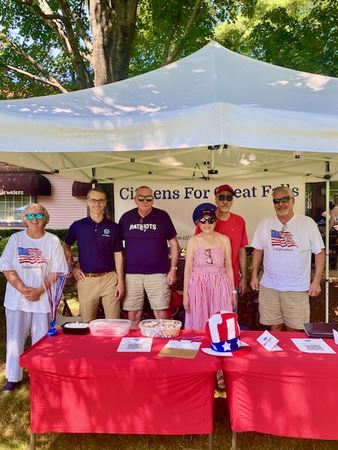
U.S. Rep. James Walkinshaw with the CFGF team at the July 4 celebration.
|
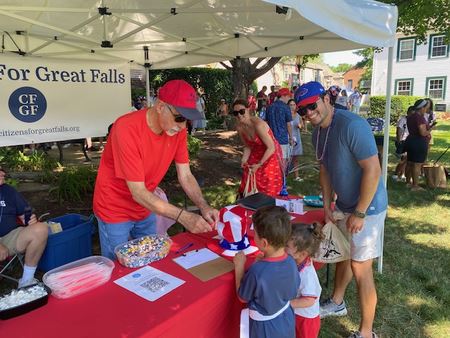
Our booth at the July 4 celebration was a hit — lots of new folks signed up for membership info, and a special thanks to everyone who helped staff it. U.S. Rep. James Walkinshaw even stopped by for a photo with the team.
|
|
CFGF Vice President Manny Dacoba greets visitors at the CFGF tent.
|
Georgetown Pike Truck Restriction — Update
You may have heard conflicting information about a May 11 meeting between GFCA, Supervisor Bierman's office, and VDOT on the Georgetown Pike truck restriction. Here's the clarity: the restriction stays in place, status quo, while VDOT studies a separate truck-length issue. We'll keep watching this one.
Trash Disposal Costs Squeeze County Budget
CFGF Board members raised concerns at their July 29 meeting over rising costs and carbon-emissions impacts tied to the county's "zero waste" initiative. Those concerns echoed what had already surfaced at the Board of Supervisors' Environmental Committee's July 7 meeting, where Supervisor Pat Herrity cited findings from a county-commissioned study not yet shared with his Board colleagues. Per the study, the Mandatory Organics Recycling strategy would generate 1,124 metric tons of CO2 equivalent annually (a social cost of carbon of about $200,000/year), with implementation costs of $11 million per year against estimated community savings of just $8 million per year. Herrity also warned that reducing the waste stream through recycling could trigger contract penalties tied to volume requirements in the county's agreement with Reworld (formerly Covanta). The exchange came amid a broader budget crunch: the reserve fund subsidizing hauling to Reworld's Lorton facility is set to run dry by mid-2027, with rising tipping fees still falling short of covering costs starting in FY 2028.
Historic Family Cemetery Threatened by Land Clearing at 1002 Sherman Court
CFGF members also raised concerns at the July 29 meeting about land clearing activity at 1002 Sherman Court, a vacant lot across from the CVS on Seneca Road that appears to be undergoing preparation for a residential development project. The parcel contains an undocumented historical family cemetery with descendants still living in Fairfax County. A senior archaeologist with the Fairfax County Park Authority's Archaeology and Collections Branch has been engaged to assess the site, and as of the meeting, no site plans for the project had been reviewed by the county. County records available online indicate a Land Disturbance Violation was opened for the property and has since been closed, with additional inspections still to be scheduled. CFGF will continue following developments on this matter.
Help Us Grow!
We need your help growing our membership — a bigger membership means a louder voice for this community. Know a neighbor who cares about Great Falls? Send them our way. And please renew your own membership; reminders are coming your way soon.
Have a Topic or Editorial to Share?
Want to see something covered in the September issue, or have an editorial to submit? We'd love to hear from you.
Thank you, as always, for your support and involvement in this community.

|
CITIZENS FOR GREAT FALLS
P.O BOX 383
GREAT FALLS, VA 22066
|
CFGF is dedicated to preserving the character, quality of life, and community values of Great Falls, Virginia.
www.citizensforgreatfalls.org
Email us at: CitizensforGreatFalls@gmail.com
You are receiving this newsletter as a member or subscriber of Citizens for Great Falls. To unsubscribe, please manage your preferences through Club Express.
|